General Description
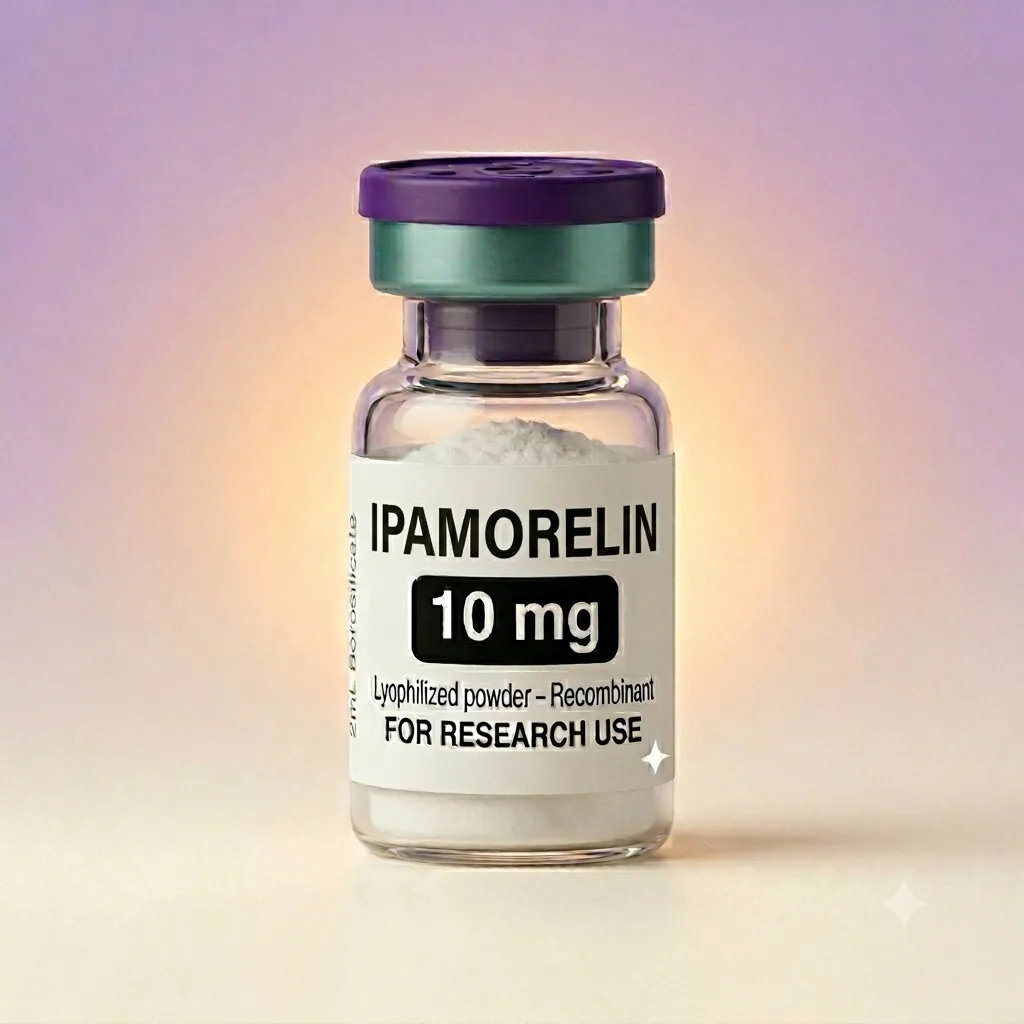
Ipamorelin is the first synthetic GHS that appears highly selective and may have the
potential to increase hGH production without affecting other pituitary hormones such as
prolactin or adrenocorticotropic hormone (ACTH). The potential increase in hGH could
promote lipolysis and the synthesis of insulin-like growth factor-1 (IGF-1) production.
Consequently, IGF-1 may become a mediator of the anabolic actions of hGH, and thus the
peptide may act to increase cell proliferation and bone and muscle anabolism.(1)
Chemical Composition
- Molecular Formula: C38H49N9O5
- Molecular Weight: 711.86 g/mol
- Other Known Titles: NNC 26-0161
Ipamorelin Peptide and Selective Agonism
Based on a 1998 murine model-based research study, researchers suggested that Ipamorelin
may release growth hormones from pituitary cells. When Ipamorelin was presented to
pentobarbitone-anesthetized pigs and rats, it reportedly exhibited growth hormone
releasing activity. Upon further observation, researchers hypothesized that, similarly
to other growth hormone (GH) stimulating peptides, Ipamorelin may be a growth receptor
agonist stimulating GH release through potential affinity at growth hormone receptors.
Furthermore, researchers commented that Ipamorelin appears to be the first GHS-R
“agonist with a selectivity for GH release similar to that displayed by GHRH. The
specificity of Ipamorelin makes this compound a very interesting candidate for future
clinical development.”(1) Scientific research studies have also suggested that
Ipamorelin may lead to increased hGH secretion, possibly without significantly affecting
other pituitary hormones such as prolactin or ACTH levels.(2)
Ipamorelin Peptide and Growth Hormone
Synthesis
In vitro studies suggest that the interaction of Ipamorelin with GHS receptors may
potentially affect somatotroph cells in the anterior pituitary gland by triggering a
series of cellular signaling events.(3) This theorized pathway involves the activation
of phospholipase C (PLC), which some researchers believe may lead to increased release
of inositol triphosphate (IP3) and diacylglycerol (DAG). This release of secondary
messenger molecules like IP3 could potentially stimulate the discharge of calcium ions
(Ca2+) from the cell's internal stores, while DAG could activate protein kinase C (PKC).
The subsequent increase in intracellular calcium levels and potential activation of PKC
are believed to result in the exocytosis of growth hormone-filled vesicles from these
pituitary cells.(3)
In late 1999, a clinical trial was conducted in eight test subjects where Ipamorelin was
presented every 15 minutes over a set period. Two hours post-study, researchers
suggested that growth hormone levels had apparently increased. More specifically,
Ipamorelin appeared to have tended to increase growth hormone levels, potentially rising
up to 80mIU/l (approximately equivalent to a concentration of about 26.6ng/ml). When
this increase is measured as a percentage compared to a placebo (with a baseline of
1.31mIU/l or 0.4ng/ml), the improvement appeared to have exceeded a 60-fold increase.(4)
Ipamorelin Peptide and Bone Tissue
It is conceivable that Ipamorelin may positively influence bone mineral density. The
theory postulates that Ipamorelin could stimulate osteoblasts (cells responsible for
bone formation) through hGH-mediated mechanismás, potentially leading to their enhanced
proliferation, growth, and specialization. In a particular study, murine models were
exposed to Ipamorelin or a placebo.(5) The impact of Ipamorelin on bone mineral density
in these mice was closely monitored via real-time dual-energy X-ray absorptiometry
(DEXA) assessments at critical sites, including the femur and L6 vertebra. Following the
experiment, femur bones were further examined using peripheral quantitative computed
tomography of the mid-diaphysis (pQCT). Preliminary findings implied that the peptide
may have contributed to increased body mass and a likely elevation in overall tibial and
vertebral BMC (bone mineral content) detected by DEXA compared to the placebo group.
Furthermore, pQCT data appeared to suggest that the observed increase in cortical BMC
may have stemmed from an enlargement in the bone's cross-sectional area. Conversely,
cortical volumetric bone mineral density (BMD, denoting the ratio of BMC to area)
appeared to remain stable. Therefore, there may have been an enlargement in femur and L6
vertebrae volumes as BMC appeared to increase while volumetric BMDs appeared
unchanged.(5)
Ipamorelin Peptide and Digestion
Researchers have delved into Ipamorelin's potential in stomach functionality, with keen
interest in its ability to possibly accelerate the gastric emptying process. For
instance, one study employed a technique to determine gastric emptying rates, which
involved monitoring the proportion of a labeled substance remaining in the stomach 15
minutes after its introduction via intragastric gavage.(6) Scientists performed
surgeries to purposely decelerate the gastric emptying process in murine models. This
deceleration was particularly notable in the control group. Conversely, Ipamorelin
appeared to have markedly accelerated the emptying process compared to the control. This
observation led the team to hypothesize that Ipamorelin might be capable of increasing
gastric emptying speed. Further investigation was initiated to delve into the compound's
action on the contractile potential of stomach smooth muscles, which were activated by
acetylcholine and electric field stimulation. Indeed, decelerated peristalsis appeared
to differ when Ipamorelin and ghrelin were studied together, suggesting the notion that
Ipamorelin may enhance gastric smooth muscle contractility.(6)
Ipamorelin Peptide and Appetite
Ipamorelin's potential actions on ghrelin receptors may lead to an enhancement in hunger
signals and, perhaps, a consequent increase in body mass. Research suggests that
research models exposed to Ipamorelin were observed to maintain an estimated 15%
increase in body weight.(7) Researchers speculate this substance might have led to a
proportional increase in fat pad weight compared to total body weight. Consequently,
DEXA scans might indicate a comparative increase in body fat percentage. Furthermore,
there is speculation among researchers that Ipamorelin might elevate serum leptin
levels, a hormone considered to play a crucial role in energy balance and hunger
regulation. This observation has led scientists to consider increased food consumption
as a potential contributor to the weight gain observed in research models exposed to
Ipamorelin. They have postulated that "GHSs increase body fat by GH-independent
mechanismás that may include increased feeding.”(7)
Ipamorelin Peptide and Nitrogen Balance
Researchers have suggested that Ipamorelin may potentially mediate anabolic action,
which may be due to its potential in hGH and IGF-1 synthesis and can be assessed through
its impact on nitrogen balance. In a distinct investigation, researchers aimed to
explore Ipamorelin's action on specific liver markers associated with
alpha-amino-nitrogen conversion during induced catabolic states.(8) The study focused on
the liver's capacity to synthesize urea-N (CUNS), which can serve as an indicator of the
organ's ability to process nitrogen. Messenger RNA (mRNA) levels related to hepatic urea
cycle enzymes were analyzed, alongside an assessment of overall nitrogen balance and a
hypothesis on nitrogen distribution in various organs. Findings suggested that
Ipamorelin might have contributed to a possible 20% reduction in CUNS compared to the
artificially induced catabolic condition. Furthermore, it might have decreased the
expression of urea cycle enzymes, possibly restored nitrogen balance, and theoretically
altered or improved nitrogen concentrations in different organs.(8)
References
- K. Raun et al., Ipamorelin, the first selective growth hormone secretagogue,
Endocrinology, November 1998.
- Sinha DK, Balasubramanian A, Tatem AJ, Rivera-Mirabal J, Yu J, Kovac J, Pastuszak AW,
Lipshultz LI. Beyond the androgen receptor: the role of growth hormone secretagogues in
the modern management of body composition in hypogonadal males. Transl Androl Urol. 2020
Mar;9(Suppl 2):S149-S159. doi: 10.21037/tau.2019.11.30. PMID: 32257855; PMCID:
PMC7108996 https://www.ncbi.nlm.nih.gov/pmc/articles/PMC7108996/
- Jiménez-Reina, L., Cañete, R., de la Torre, M. J., & Bernal, G. (2002). Influence of
chronic treatment with the growth hormone secretagogue Ipamorelin, in young female rats:
somatotroph response in vitro. Histology and histopathology, 17(3), 707–714. https://doi.org/10.14670/HH-17.707
- Gobburu, J.V.S., Agersø, H., Jusko, W.J. et al. Pharmacokinetic-Pharmacodynamic Modeling
of Ipamorelin, a Growth Hormone Releasing Peptide, in Human Volunteers. Pharm Res 16,
1412–1416 (1999).
- Svensson, J., Lall, S., Dickson, S. L., Bengtsson, B. A., Rømer, J., Ahnfelt-Rønne, I.,
Ohlsson, C., & Jansson, J. O. (2000). The GH secretagogues ipamorelin and GH-releasing
peptide-6 increase bone mineral content in adult female rats. The Journal of
endocrinology, 165(3), 569–577. https://doi.org/10.1677/joe.0.1650569
- Greenwood-Van Meerveld, B., Tyler, K., Mohammadi, E., & Pietra, C. (2012). Efficacy of
ipamorelin, a ghrelin mimetic, on gastric dysmotility in a rodent model of postoperative
ileus. Journal of experimental pharmacology, 4, 149–155. https://doi.org/10.2147/JEP.S35396
- Lall, S., Tung, L. Y., Ohlsson, C., Jansson, J. O., & Dickson, S. L. (2001). Growth
hormone (GH)-independent stimulation of adiposity by GH secretagogues. Biochemical and
biophysical research communications, 280(1), 132–138. https://doi.org/10.1006/bbrc.2000.4065
- Aagaard, N. K., Grøfte, T., Greisen, J., Malmlöf, K., Johansen, P. B., Grønbaek, H.,
Ørskov, H., Tygstrup, N., & Vilstrup, H. (2009). Growth hormone and growth hormone
secretagogue effects on nitrogen balance and urea synthesis in steroid treated rats.
Growth hormone & IGF research: official journal of the Growth Hormone Research Society
and the International IGF Research Society, 19(5), 426–431. https://doi.org/10.1016/j.ghir.2009.01.001