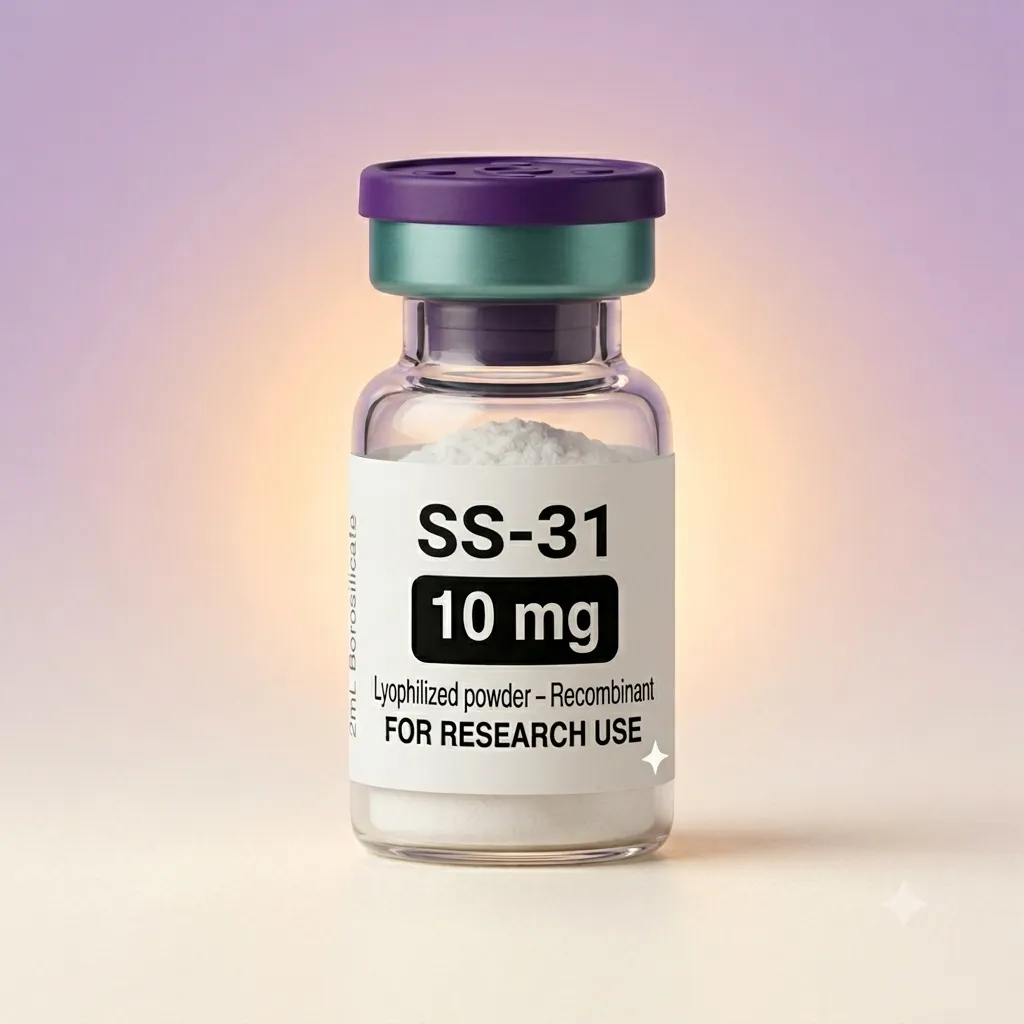
General Description
Various studies have explored the potential benefits of SS-31 on cellular health and
physical performance. The following summarizes some of the main actions and potential
effects attributed to this peptide:
- Mitochondrial Protection: SS-31 stabilizes the inner membranes of
mitochondria, preserving their structure and function even under stress conditions.
Thus, it helps prevent mitochondrial dysfunction associated with aging or
disease[3].
- Increased Energy Production: By optimizing the efficiency of the
electron transport chain, SS-31 increases ATP production in cells. This translates
to better energy performance in high-demand tissues (such as cardiac and skeletal
muscle) and reduced fatigue during physical activity[4][5].
- Reduction of Oxidative Stress: SS-31 decreases the generation of
reactive oxygen species (free radicals) in mitochondria. Thereby, it protects cells
from chronic oxidative damage, reduces cellular inflammation, and contributes to
maintaining the integrity of cellular components (DNA, proteins, and lipids) over
time[6].
- Potential Neuroprotection: Thanks to its mitochondria-targeted
action, SS-31 may protect neurons from energy dysfunction. Research suggests it
supports brain health by reducing oxidative stress in nerve cells, which could favor
memory and cognitive function during aging[7].
- Improved Muscle Performance: SS-31 improves muscle bioenergetics,
increasing efficient oxygen use and energy availability in muscle. As a result,
studies indicate it could reduce fatigue during prolonged exercise and accelerate
muscle recovery after intense activity[8].
- Anti-aging Potential: By counteracting one of the central factors
of cellular aging (mitochondrial deterioration), SS-31 could contribute to healthier
aging. It is postulated that its long-term use would promote more efficient cellular
metabolism in multiple organs, delaying to some extent the onset of age-related
functional declines[9].
Specifications
- Molecular Formula: C32H49N9O5[10]
- Molecular Weight: ≈639.8 daltones (g/mol)[10]
- Other known names: Elamipretide (code SS-31); also referred to in
research as MTP-131 or Bendavia[10].
Discovery of SS-31 and Mechanism of Action
SS-31 belongs to a family of peptides known as Szeto-Schiller (SS), discovered in the
early 2000s with the aim of improving mitochondrial function in disease and aging
conditions[11]. These peptides were designed to be small and permeable enough to enter
cells and concentrate in mitochondria, optimizing electron transport efficiency and
energy production without negatively affecting healthy cells. In initial studies with
isolated mitochondria and cell cultures, SS-31 was shown to restore cellular
bioenergetics: it improved electron flow through the respiratory chain, elevated ATP
synthesis, and reduced ROS (free radical) production within cells to near-normal
levels[12]. Its mechanism of action is primarily attributed to its binding to
cardiolipin in the inner mitochondrial membrane, thereby stabilizing mitochondrial
cristae (the internal structure of mitochondria) and preventing membrane disruption
under stress conditions[13]. Thanks to this targeted action, SS-31 keeps mitochondria
functioning more efficiently and resistant to oxidative damage.
SS-31 and Muscle Atrophy
A prominent finding in preclinical research is SS-31's ability to protect skeletal
muscle from disuse atrophy. In studies with immobilized mice (a model of muscle atrophy
due to inactivity), treatment with SS-31 prevented the increase in mitochondrial
oxidative stress and muscle mass loss that normally accompanies prolonged lack of muscle
activity[14]. That is, mice subjected to immobilization maintained their musculature
better when receiving SS-31 compared to those that did not. This effect suggests that
SS-31 could counteract degenerative processes in muscle during periods of inactivity
(e.g., in long convalescences or space travel), helping to preserve muscle integrity and
functionality.
SS-31 and Muscle Aging
The decline in mitochondrial functional capacity contributes to age-related muscle
weakening. In a notable study with aged mice (~26 months old, equivalent to advanced
age), chronic administration of SS-31 for 8 weeks reversed several age-related muscle
deficits[15]. Specifically, SS-31 improved maximal ATP production and restored redox
balance (balance between oxidants and antioxidants) in the skeletal muscle of these old
mice[15]. Notably, this improvement was achieved without increasing mitochondrial
number, indicating that SS-31 made existing mitochondria more efficient rather than
stimulating mitochondrial biogenesis. In functional termás, treated muscles showed
greater fatigue resistance and some recovery of mass and strength compared to untreated
controls. As a result, aged mice treated with SS-31 tolerated exercise better: they were
able to run significantly longer on a treadmill than untreated aged mice[5]. These
findings indicate that improving mitochondrial function via SS-31 can translate into
more functional and resilient muscles in old age, pointing to possible applications for
combating sarcopenia (age-associated muscle mass loss).
SS-31 and Heart Disease
Given that the heart is an organ of incredibly high energy demand, mitochondrial
function is critical for cardiovascular health. In preclinical studies of heart failure
(e.g., in animal models with pressure overload inducing heart failure), SS-31 showed the
ability to restore cellular bioenergetics of the heart: it improved the structure and
function of mitochondria in the myocardium, increasing energy production and reducing
ROS levels towards near-normal values[16]. As a consequence of this mitochondrial
optimization, improvements in the heart's pumping function and a normalization in
cardiolipin composition (a key phospholipid of the inner mitochondrial membrane) were
observed in animal models of ventricular dysfunction and heart failure[17]. A
significant advance is that this peptide has come to be evaluated in humans: the US FDA
granted accelerated approval to elamipretide (SS-31) under the trade name Forzinity™ for
the treatment of Barth syndrome[18]. Barth syndrome is a rare genetic disease in which
mitochondria (especially in the heart) present abnormal functioning; in a clinical trial
with patients of this condition, treatment with SS-31 managed to improve muscle strength
and cardiac function of patients[18]. This marked the first therapy of its kind directed
at mitochondrial repair in a human disease, highlighting the potential of SS-31 in the
field of cardiomyopathies of mitochondrial origin.
SS-31 and Neuroprotection
Neurons, like muscle cells, depend heavily on the energy provided by their mitochondria.
In models of neurodegenerative diseases and brain injury, SS-31 has demonstrated notable
neuroprotective effects. For example, in cultures of neurons exposed to intense
oxidative stress, treatment with SS-31 significantly reduced free radical production,
restored mitochondrial membrane potential, and prevented apoptosis (programmed cell
death) of vulnerable neurons[19]. These results suggest that SS-31 protects nerve cells
by maintaining their mitochondrial function and preventing oxidative damage that
triggers cell death. Similarly, in animal models of neurological disorders such as
Alzheimer's and Parkinson's disease, the SS-31 peptide showed capacity to improve
mitochondrial function in the brain and attenuate some of the impairments associated
with the neurodegenerative process[20]. Taken together, these findings indicate that
SS-31 could protect brain cells by sustaining their energy metabolism and reducing
oxidative stress, opening the door to potential therapies for conditions where
mitochondrial dysfunction plays a central role (e.g., neurodegenerative diseases,
ischemic brain injury, etc.).
Safety and Side Effects
To date, SS-31 has shown a generally favorable safety profile in preclinical studies and
initial human trials[21]. Due to its localized action in mitochondria and because it
does not interact with the body's hormonal pathways, it tends to be well tolerated by
test subjects[22]. Observed side effects are considered mild. The most common is a
reaction at the injection site – since SS-31 is usually administered subcutaneously or
intravenously in research settings – which may include redness, irritation, or local
discomfort[23]. In some cases, transient symptomás such as slight fatigue, passing
headache, or gastrointestinal discomfort (nausea) at the start of treatment have been
reported, which remit spontaneously after a short time[24]. Important to note that no
significant toxic effects have been identified in animals or humans during short to
medium-term studies[25]. However, data on its long-term use in humans are still limited.
As a precaution, experts recommend that SS-31 only be used within supervised research
protocols. In special populations, such as pregnant women or people with pre-existing
mitochondrial diseases, its use outside controlled clinical contexts is discouraged due
to the lack of conclusive data on its safety in those cases.
References
- [1] [2] [3] [4] [6] [7] [8] [9] [21] [22] [23] [24] [25] SS-31 Peptide (Elamipretide) |
Benefits, Dosage, Side Effects – Swolverine. https://swolverine.com/blogs/blog/ss-31-peptide-mitochondrial-protection-and-performance-potential
- [5] [15] Improving mitochondrial function with SS-31 reverses age-related redox stress
and improves exercise tolerance in aged mice - PMC. https://pmc.ncbi.nlm.nih.gov/articles/PMC6588449/
- [10] Elamipretide | C32H49N9O5 | CID 11764719 - PubChem - NIH. https://pubchem.ncbi.nlm.nih.gov/compound/Elamipretide
- [11] [12] [14] [18] Elamipretide (Brand Name FORZINITY™ for Barth Syndrome) -
Friedreich's Ataxia Research Alliance. https://www.curefa.org/drug-development/elamipretide/
- [13] SS-31 (Elamipretide) – Mitochondrial Research Peptide Colombia | Poly Biotech. https://www.polybiotech.co/products/ss-31-elamipretide-10mg
- [16] [17] Beneficial effects of SS-31 peptide on cardiac mitochondrial dysfunction in
tafazzin knockdown mice | Scientific Reports. https://www.nature.com/articles/s41598-022-24231-4
- [19] alzdiscovery.org. https://www.alzdiscovery.org/uploads/cognitive_vitality_media/SS-31-Cognitive-Vitality-For-Researchers.pdf
- [20] Elamipretide Peptide | Elamipretide Synthetic Hormone | ProSpec. https://www.prospecbio.com/elamipretide