General Description
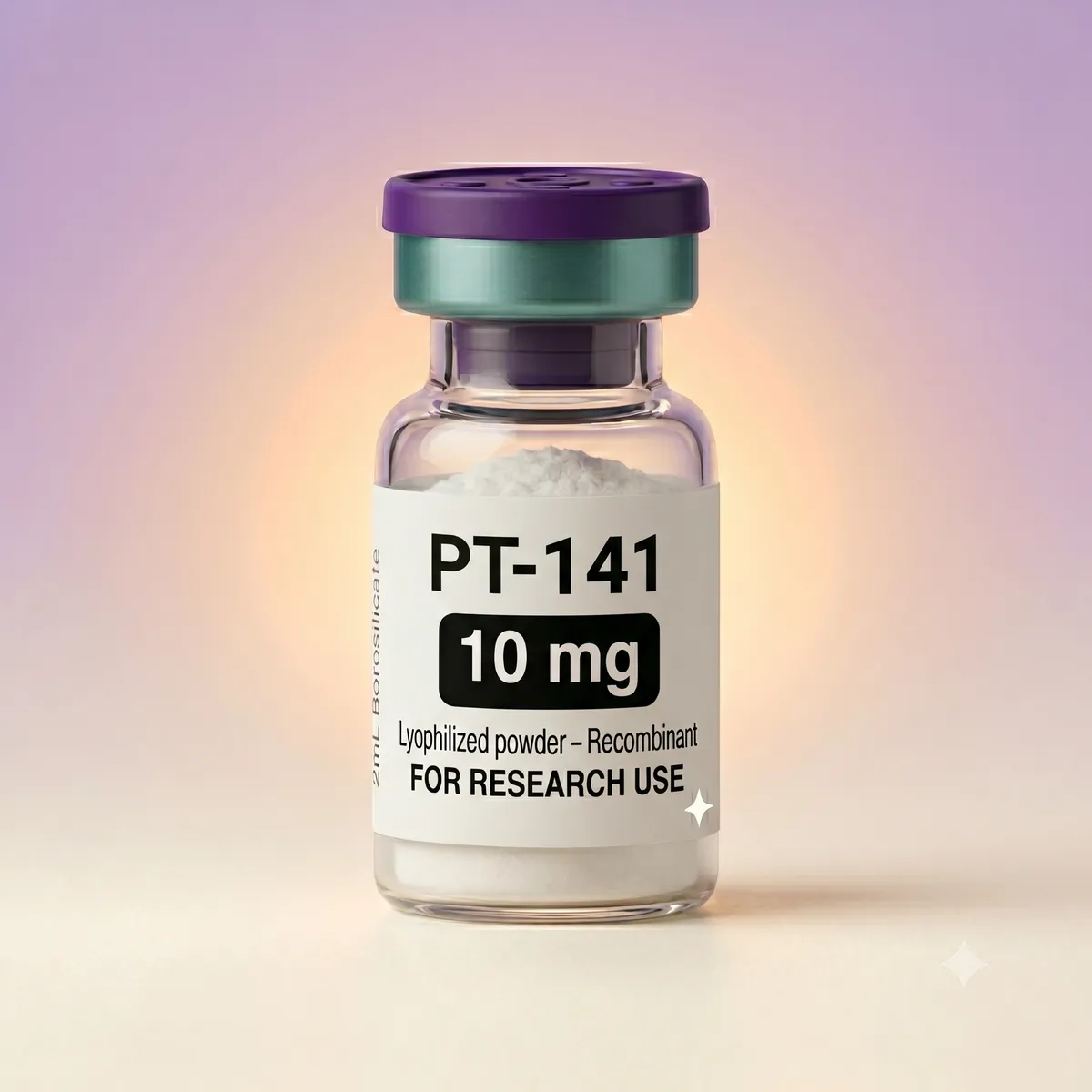
Bremelanotide, also known as PT-141, is a cyclic synthetic peptide composed of seven
amino acids.(1) The synthetic peptide PT-141 appears to be an agonist of melanocortin
receptors, similar to the natural hormone alpha-MSH.(2) It is a metabolite of another
synthetic analog called Melanotan II. Initial studies suggested that melanocortin
hormones primarily affect melanocyte receptors responsible for skin pigmentation.
However, further studies in mouse models indicated that a select group induced sexual
arousal, leading to the development of Bremelanotide. Cyclic synthetic analogs of
alpha-MSH, like PT-141, are potent agonists believed to act on MC3 and MC4 receptors in
the central nervous system, thus potentially affecting sexual behavior.(3)
Chemical Composition(4)
- Molecular Formula: C50H68N14O10
- Molecular Weight: 1025.2 g/mol
- Other Titles: Bremelanotide, PT-141
- PubChem ID: 9941379
- CAS Number: 189691-06-3
PT-141 and Initial Studies
Early research on alpha-MSH analogs observed unexpected effects on sexual function.
Originally intended to study sunless tanning and pigmentation, the administration of
Melanotan-II in male test subjects resulted in spontaneous erections. This led to the
isolation of the active metabolite, which became PT-141 (Bremelanotide), focusing on its
potential aphrodisiac properties.
PT-141 and Sexual Arousal
Research has widely suggested that the PT-141 peptide may act as a potential treatment
for sexual dysfunction in both men (erectile dysfunction or impotence) and women (sexual
arousal disorder). Studies in male rats showed that systemic administration initiated
erection. Unlike other sexual enhancers, research suggests the peptide does not act on
the vascular system. Instead, PT-141 might work on the central nervous system (brain) to
directly activate dopamine receptors and awaken sexual arousal.(5)
PT-141 and The Central Nervous System (CNS)
Given that PT-141 is a synthetic analog of the alpha-MSH hormone, it is postulated to
interact predominantly with central melanocortin receptors MC3 and MC4. Although
alpha-MSH is a non-selective agonist of melanocortin receptors MC1-5, the cyclic
structure and properties of PT-141 limit its interactions. Studies in rodents have
suggested that PT-141 induces lordosis in females and potentiates erection in males
through central actions, specifically in regions of the hypothalamus associated with
sexual behavior.(6) This central action contrasts with PDE5 inhibitors (like sildenafil)
which primarily act on peripheral vascular mechanismás.
PT-141 and Ingestive Behavior
In addition to sexual function, MC4 receptor agonists are implicated in the regulation
of food intake and energy balance. Some preclinical studies have observed that the
activation of these receptors by analogs like PT-141 could suppress appetite and
influence metabolism, although these effects are secondary to its primary investigated
impact on sexual function.
References
- Pfaus, J., Giuliano, F., & Gelez, H. (2007). Bremelanotide: an overview of preclinical
CNS effects on female sexual function. The journal of sexual medicine, 4 Suppl 4,
269–279. https://doi.org/10.1111/j.1743-6109.2007.00610.x
- National Center for Biotechnology Information (2023). PubChem Compound Summary for CID
9941379, Bremelanotide. Retrieved August 10, 2023 from https://pubchem.ncbi.nlm.nih.gov/compound/Bremelanotide.
- Molinoff, P. B., Shadiack, A. M., Earle, D., Diamond, L. E., & Quon, C. Y. (2003).
PT-141: a melanocortin agonist for the treatment of sexual dysfunction. Annals of the
New York Academy of Sciences, 994, 96–102. https://doi.org/10.1111/j.1749-6632.2003.tb03167.x
- Renquist, B. J., Lippert, R. N., Sebag, J. A., Ellacott, K. L., & Cone, R. D. (2011).
Physiological roles of the melanocortin MC3 receptor. European journal of pharmacology,
660(1), 13–20. https://doi.org/10.1016/j.ejphar.2010.12.025
- Adan, R. A., Tiesjema, B., Hillebrand, J. J., la Fleur, S. E., Kas, M. J., & de Krom, M.
(2006). The MC4 receptor and control of appetite. British journal of pharmacology,
149(7), 815–827. https://doi.org/10.1038/sj.bjp.0706929
- Pfaus, J. G., Shadiack, A., Van Soest, T., Tse, M., & Molinoff, P. (2004). Selective
facilitation of sexual solicitation in the female rat by a melanocortin receptor
agonist. Proceedings of the National Academy of Sciences of the United States of
America, 101(27), 10201–10204. https://doi.org/10.1073/pnas.0400491101
- Vemulapalli, R., Kurowski, S., Salisbury, B., Parker, E., & Davis, H. (2001). Activation
of central melanocortin receptors by MT-II increases cavernosal pressure in rabbits by
the neuronal release of NO. British journal of pharmacology, 134(8), 1705–1710. https://doi.org/10.1038/sj.bjp.0704437
- Thurston, L., Hunjan, T., Mills, E. G., Wall, M. B., Ertl, N., Phylactou, M., Muzi, B.,
Patel, B., Alexander, E. C., Suladze, S., Modi, M., Eng, P. C., Bassett, P. A., Abbara,
A., Goldmeier, D., Comninos, A. N., & Dhillo, W. S. (2022). Melanocortin 4 receptor
agonism enhances sexual brain processing in women with hypoactive sexual desire
disorder. The Journal of clinical investigation, 132(19), e152341. https://doi.org/10.1172/JCI152341