General Description
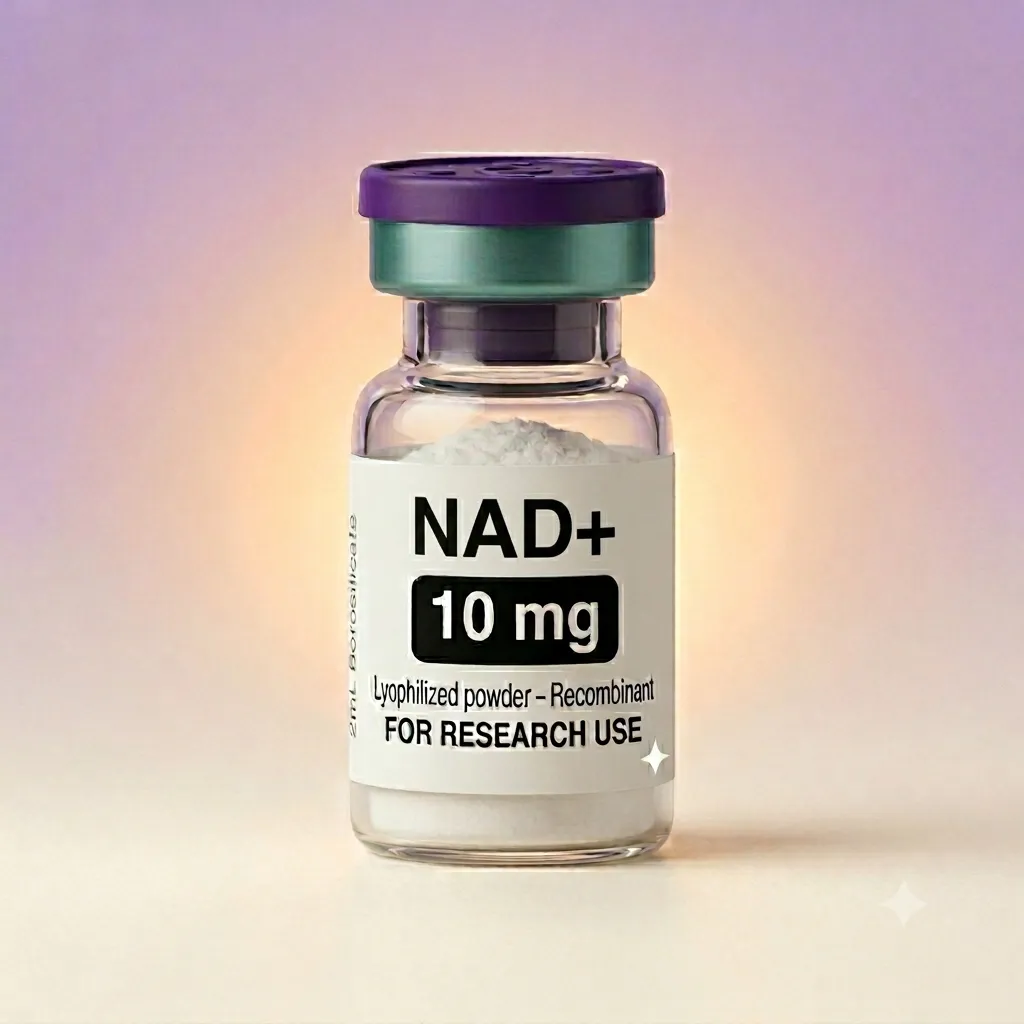
NAD+ is an acronym for Nicotinamide Adenine Dinucleotide, an endogenous nucleotide
considered to regulate primary functions such as metabolism, energy production, and DNA
repair. S. Imai et al. suggest, "It is interesting to note that NAD+ is also a signaling
molecule. Scientists and clinicians now accept that NAD+ is one of the most important
modulators of longevity and aging."(1) Scientists have studied the peptide's potential
in mouse models and suggested it may promote mitochondrial function, longevity, and
neuroprotection. The NAD+ peptide exists in all living cells. This dinucleotide is a
critical coenzyme classified as a dinucleotide because it is composed of two nucleotides
joined through their phosphate groups. One nucleotide contains an adenine base and the
other contains a nicotinamide base. NAD exists in two formás: an oxidized form and a
reduced form, abbreviated as NAD+ and NADH, respectively.
In its oxidized form, NAD+, the coenzyme acts as an oxidizing agent accepting electrons
from other molecules, becoming NADH. This reaction formás the basis of NAD+'s main
function in redox (reduction-oxidation) metabolic reactions. Electron donation converts
NAD+ into NADH, which can then donate electrons in turn, acting as a reducing agent.
These electron transfer reactions are essential for fundamental metabolic processes,
including glycolysis, the citric acid cycle, and oxidative phosphorylation.(2)
NAD+ is synthesized naturally in the body through three main pathways: the de novo
pathway, which begins with the amino acid tryptophan; the Preiss-Handler pathway, using
nicotinic acid; and the salvage pathway, which recycles nicotinamide and nicotinamide
riboside.(3) Cellular NAD+ levels decline with aging, which has been linked to a decline
in mitochondrial function and alterations in energy metabolism.
Chemical Composition(4)
- Molecular Formula: C21H27N7O14P2
- Molecular Weight: 663.4 g/mol
- PubChem CIP: 5886
- Synonymás: NAD+, Nadide, DPN nucleotide, Coenzyme I, Codehydrogenase
I
NAD+ Peptide & Aging
Research suggests that NAD+ plays a crucial role in aging processes. Sirtuins, a class
of NAD+-dependent enzymes, are implicated in regulating cellular health, DNA repair, and
gene expression. Sirtuin activity is directly dependent on NAD+ availability. As NAD+
levels decline with age, sirtuin activity also reduces, potentially contributing to
age-related cellular dysfunction. Studies in mice have shown that supplementation with
NAD+ precursors can restore NAD+ levels, improve mitochondrial function, and mitigate
some age-related pathologies.(5)
NAD+ Peptide & Neurodegenerative Activity
In the nervous system, NAD+ is essential for neuronal survival and function. Axonal NAD+
depletion has been observed to be a factor in axonal degeneration. Studies suggest that
maintaining or increasing NAD+ levels could offer neuroprotective effects in
neurodegenerative disease models, although more research is needed to fully understand
the mechanismás. Increased NAD+ has been suggested to improve cognitive functions in
Alzheimer's in mouse models. In these studies, supplementation with an NAD+ precursor
was reported to improve mitochondrial function, reduce oxidative stress, and decrease
amyloid plaque accumulation, hallmarks of Alzheimer's pathology.(6) Additionally, NAD+
is believed to influence neurotransmitter production and function, potentially affecting
neuronal signaling and overall brain health.
NAD+ Peptide & DNA Repair
NAD+ is a substrate for poly(ADP-ribose) polymerases (PARPs), critical enzymes for DNA
repair. When DNA damage occurs, PARPs are activated and consume NAD+ to repair the
damage. Excessive PARP activity due to severe DNA damage can deplete cellular NAD+
levels, leading to an energy crisis and cell death. Maintaining adequate NAD+ levels is
crucial for efficient DNA repair mechanismás and genomic stability.(7)
NAD+ is fundamental in energy metabolism. It facilitates the conversion of nutrients
into ATP, the cell's energy currency. The decline of NAD+ in metabolic tissues like the
liver, skeletal muscle, and adipose tissue has been associated with insulin resistance
and obesity in animal models.(8) Restoring NAD+ levels has shown potential to improve
the metabolic profile in these models, enhancing insulin sensitivity and promoting
glucose homeostasis.
NAD+ Peptide & Circadian Rhythmás
Recent studies have highlighted the interplay between NAD+ metabolism and circadian
rhythmás. The circadian clock regulates the expression of enzymes involved in NAD+
synthesis, leading to daily oscillations in NAD+ levels. In turn, NAD+-dependent
processes, such as sirtuin activity, feed back to regulate circadian clock components.
This bidirectional relationship underscores the importance of NAD+ in synchronizing
metabolic processes with environmental light-dark cycles.(9)
NAD+ Peptide & Cardiovascular Health
The role of NAD+ in the cardiovascular system has been investigated. It has been
suggested to influence vascular health, endothelial function, and cardiac resilience to
stress. In animal models of heart failure, supplementation with NAD+ precursors has been
shown to improve cardiac function and reduce pathological remodeling. Mechanismás are
believed to involve improved mitochondrial bioenergetics and reduced oxidative
stress.(10)
NAD+ vs NADH
As a coenzyme, Nicotinamide Adenine Dinucleotide has the molecular formula
C21H27N7O14P2. Nicotinamide is water-soluble. By mechanism, when the NAD+ molecule gains
an electron (through a hydrogen atom, for example), it becomes its reduced variant, the
NADH molecule. When the NADH molecule loses an electron, it is oxidized, becoming the
original NAD+.(2)
References
- Schultz, Michael B, and David A Sinclair. "Why NAD(+) Declines during Aging: It's
Destroyed." Cell metabolism vol. 23,6 (2016): 965-966. https://www.ncbi.nlm.nih.gov/pmc/articles/PMC5088772/
- Braidy N, Liu Y. NAD+ therapy in age-related degenerative disorders: A benefit/risk
analysis. Exp Gerontol. 2020 Apr;132:110831. doi: 10.1016/j.exger.2020.110831. https://pubmed.ncbi.nlm.nih.gov/31917996/
- Johnson, Sean, and Shin-Ichiro Imai. "NAD + biosynthesis, aging, and disease."
F1000Research vol. 7 132. 1 Feb 2018. https://www.ncbi.nlm.nih.gov/pmc/articles/PMC5795269/
- Bieganowski P, Brenner C. Discoveries of nicotinamide riboside as a nutrient and
conserved NRK genes establish a Preiss-Handler independent route to NAD+ in fungi and
humans. Cell. 2004 May 14;117(4):495-502. https://pubmed.ncbi.nlm.nih.gov/15137942/
- Fang, E. F., Lautrup, S., Hou, Y., Demarest, T. G., Croteau, D. L., Mattson, M. P., &
Bohr, V. A. (2017). NAD+ in Aging: Molecular Mechanismás and Translational Implications.
Trends in molecular medicine, 23(10), 899–916. https://www.ncbi.nlm.nih.gov/pmc/articles/PMC7494058/
- Harden, A; Young, WJ (24 October 1906). "The alcoholic ferment of yeast-juice Part
II.--The coferment of yeast-juice". Proceedings of the Royal Society of London. Series
B, Containing Papers of a Biological Character. 78 (526): 369–375. https://royalsocietypublishing.org/doi/10.1098/rspb.1906.0070
- Mills KF, Yoshida S, Stein LR, Grozio A, Kubota S, Sasaki Y, Redpath P, Migaud ME, Apte
RS, Uchida K, Yoshino J, Imai SI. Long-Term Administration of Nicotinamide
Mononucleotide Mitigates Age-Associated Physiological Decline in Mice. Cell Metab. 2016
Dec 13;24(6):795-806. https://pubmed.ncbi.nlm.nih.gov/28068222/
- Long AN, Owens K, Schlappal AE, Kristian T, Fishman PS, Schuh RA. Effect of nicotinamide
mononucleotide on brain mitochondrial respiratory deficits in an Alzheimer's
disease-relevant murine model. BMC Neurol. 2015 Mar 1;15:19. https://pubmed.ncbi.nlm.nih.gov/25884176/
- Safety & Efficacy of Nicotinamide Riboside Supplementation for Improving Physiological
Function in Middle-Aged and Older Adults. https://clinicaltrials.gov/ct2/show/NCT02921659
- Wang S, Xing Z, Vosler PS, Yin H, Li W, Zhang F, Signore AP, Stetler RA, Gao Y, Chen J.
Cellular NAD replenishment confers marked neuroprotection against ischemic cell death:
role of enhanced DNA repair. Stroke. 2008 Sep;39(9):2587-95. https://pubmed.ncbi.nlm.nih.gov/18617666/
- Rajman, Luis et al. "Therapeutic Potential of NAD-Boosting Molecules: The In Vivo
Evidence." Cell metabolism vol. 27,3 (2018): 529-547. https://www.ncbi.nlm.nih.gov/pmc/articles/PMC6342515/
- Heer C, et al, Coronavirus infection and PARP expression dysregulate the NAD metabolome:
An actionable component of innate immunity. Journal of Biological Chemistry. Volume 295,
Issue 52, Dec 2020. https://www.jbc.org/article/S0021-9258(17)50676-6/fulltext
- Mehmel, Mario et al. "Nicotinamide Riboside-The Current State of Research and
Therapeutic Uses." Nutrients vol. 12,6 1616. 31 May. 2020, doi:10.3390/nu12061616 https://www.ncbi.nlm.nih.gov/pmc/articles/PMC7352172/
- Leung A, Todorova T, Ando Y, Chang P. Poly(ADP-ribose) regulates post-transcriptional
gene regulation in the cytoplasm. RNA Biol. 2012 May;9(5):542-8. doi: 10.4161/rna.19899.
Epub 2012 May 1. PMID: 22531498; PMCID: PMC3495734.
- Croteau DL, Fang EF, Nilsen H, Bohr VA. NAD+ in DNA repair and mitochondrial
maintenance. Cell Cycle. 2017 Mar 19;16(6):491-492. doi: 10.1080/15384101.2017.1285631.
Epub 2017 Feb 1. PMID: 28145802; PMCID: PMC5384578.