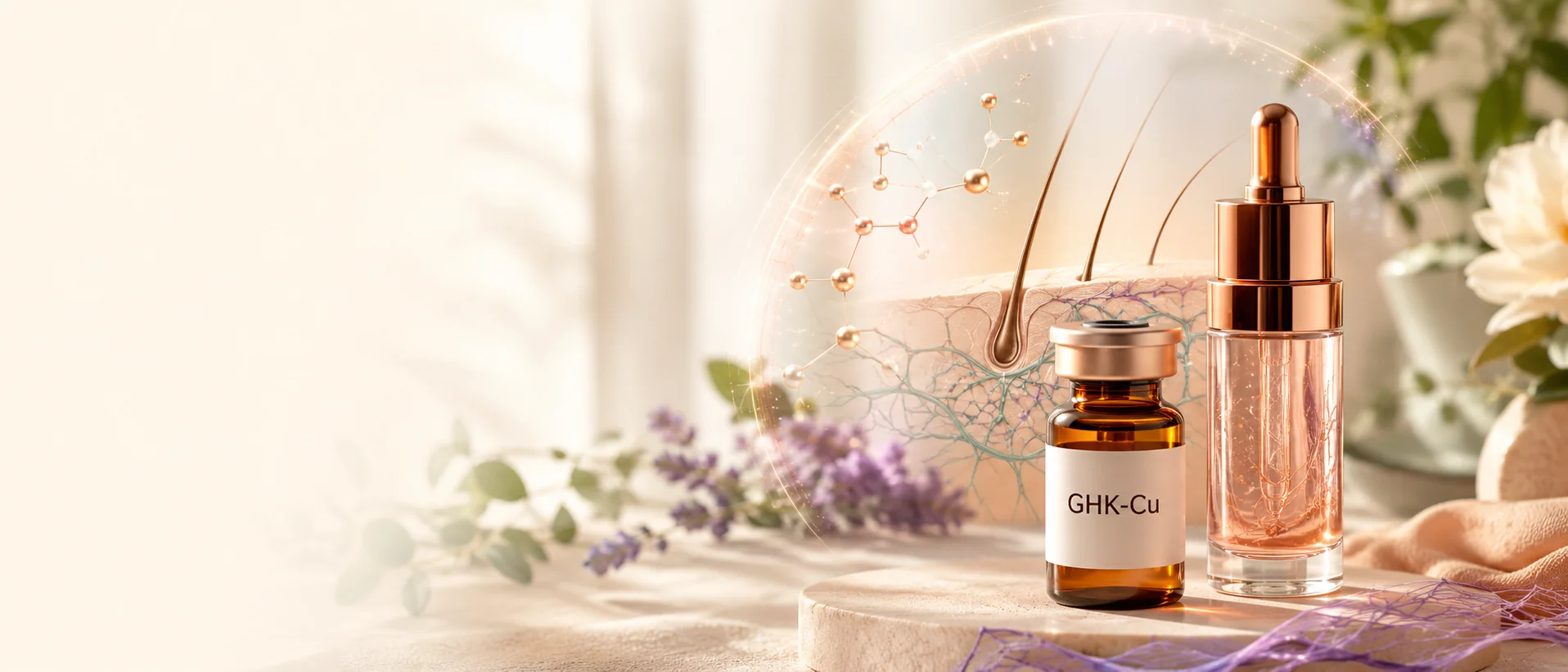
Hair loss and thinning are common concerns that affect both men and women, and the treatment story often stops at pharmaceutical solutions. But GHK-Cu is changing that narrative.
What Is GHK-Cu?
GHK-Cu stands for glycyl-L-histidyl-L-lysine bound to copper (II) — a natural tripeptide complex first identified in human plasma in the 1970s. It is found throughout the body in blood, saliva, and urine, but its levels decline significantly with age. At age 20, concentrations are much higher than at 60, which correlates with slower healing, reduced skin quality, and diminished hair health.
Unlike medications that target a single pathway, GHK-Cu acts as a bioregulatory molecule, supporting a wide range of cellular processes. Its primary functions include:
- Wound healing and tissue repair: accelerates skin recovery and reduces scarring.
- Collagen and elastin synthesis: strengthens the extracellular matrix that supports both skin and hair follicles.
- Anti-inflammatory signaling: reduces harmful cytokines that contribute to follicle miniaturization and scalp irritation.
- Antioxidant defense: enhances natural protection against oxidative stress, a major factor in aging and hair loss.
- Gene expression modulation: influences thousands of genes related to growth, repair, and metabolic regulation.
Because of these properties, GHK-Cu has been widely studied in dermatology and regenerative medicine. More recently, its ability to stimulate hair follicles, improve scalp circulation, and create a healthier growth environment has made it a promising candidate for hair restoration.
Mechanism of Action: How GHK-Cu Works for Hair
GHK-Cu promotes hair growth through multiple biological pathways that target both follicle health and the scalp environment.
1. Stimulates Hair Follicle Activity
→ Encourages dormant follicles to re-enter the growth
phase (anagen).
→ Increases follicle size, leading to thicker
hair strands.
→ Prolongs the active growth cycle, reducing
time in shedding phases.
2. Enhances Collagen and Elastin Production
→ Strengthens the structural matrix around
follicles.
→ Provides better anchoring for hair shafts.
→ Creates a
healthier scalp environment for long-term growth.
3. Improves Blood Flow and Nutrient Delivery
→ Promotes angiogenesis (formation of new capillaries)
around follicles.
→ Improves circulation, ensuring follicles
receive oxygen and nutrients.
→ Supports regeneration in areas affected by
thinning or miniaturization.
4. Reduces Scalp Inflammation
→ Reduces pro-inflammatory cytokines that contribute to follicle
damage.
→ Helps combat conditions like irritation, sensitivity, or
scalp buildup.
→ Creates a more favorable environment for new
growth.
5. Provides Antioxidant Protection
→ Increases the activity of natural antioxidant
enzymes.
→ Reduces oxidative stress that accelerates follicle
aging.
→ Protects hair from environmental damage such as UV radiation or pollution.
6. Modulates Gene Expression
→ Influences thousands of genes linked to cell repair and growth.→ Balances processes that support regeneration while limiting those that accelerate aging.→ Provides a broad-spectrum effect on scalp and follicle health.
Benefits of GHK-Cu for Hair Growth
1. Stimulates New Hair Growth
→ GHK-Cu activates dormant follicles and encourages them to
re-enter the anagen (growth) phase.
→ By increasing follicle size and activity,
it can produce visible regrowth in areas experiencing
thinning.
→ This makes it especially useful in early to moderate stages
of hair loss, when follicles are still present but dormant.
2. Thickens and Strengthens Existing Hair
→ Enlarges follicle size, producing thicker
hair shafts.
→ Improves the density and volume of existing hair,
reducing the appearance of thinning.
→ Strengthens the structural support
of the scalp, which helps anchor hair more effectively and reduces
breakage.
3. Improves Scalp Health
→ Reduces inflammation and irritation that contribute to
follicle miniaturization.
→ Balances the scalp environment,
making it less hostile to hair growth.
→ Promotes better
circulation, ensuring follicles are consistently nourished.
4. Protects Against Oxidative Stress
→ Neutralizes free radicals that damage follicles and
accelerate hair aging.
→ Enhances the activity of the body's natural
antioxidant systems.
→ Protects against environmental factors such as
UV exposure and pollution that weaken scalp health.
5. Supports Hair Pigmentation
→ Copper plays a vital role in melanin
metabolism, which determines hair color.
→ By improving copper
bioavailability within the follicle, GHK-Cu may help preserve natural
pigmentation.
→ This means it not only encourages growth but also supports
healthier, more vibrant-looking hair.
6. Complements Other Treatments
→ Can be safely combined with minoxidil,
finasteride, microneedling, or platelet-rich plasma (PRP) therapy.
→ Works
through entirely different mechanisms, adding a regenerative effect
that complements standard treatments.
→ Offers a non-hormonal alternative
for individuals who prefer to avoid pharmaceutical drugs.
GHK-Cu Dosage and Application
GHK-Cu is most commonly delivered as a topical serum or scalp solution.
Typical Concentrations
→ Most cosmetic formulations contain 0.5%–2%
GHK-Cu.
→ Lower concentrations (0.5–1%) are used for general scalp
health and maintenance.
→ Higher concentrations (1–2%) are typically
applied in hair restoration protocols.
How to Apply
→ Apply directly to the scalp, focusing on areas
of thinning.
→ Best used on a clean, dry scalp for maximum
absorption.
→ Gently massage into the scalp to improve penetration and
circulation.
→ Do not rinse — allow the serum to absorb completely.
Frequency
→ Standard use is once daily, although some regimens
may recommend twice-daily applications.
→ Consistency is critical
— skipping applications reduces overall effectiveness.
Onset of Effects
→ Subtle improvements in scalp health and hair
texture may appear within 4–8 weeks.
→ Noticeable changes in thickness and
density typically occur around the 3–6 month mark.
→ For sustained
results, long-term use is recommended, as hair follicles
require continuous support.
Combination Protocols
→ Can be layered with minoxidil (applied at different
times of day to avoid interference).
→ Often combined with microneedling,
which enhances delivery to deeper layers of the scalp.
→ Works
synergistically when supported by proper nutrition (protein, essential fatty
acids, vitamins, minerals).
Patch Test
→ Always perform a small skin patch test before
full application.
→ Mild irritation may occur in sensitive
individuals — discontinue use if persistent redness or itching develops.
Side Effects and Safety
General Tolerability
→ Most individuals tolerate topical GHK-Cu without
issues.
→ When used in scalp serums, side effects
are typically mild and uncommon.
→ Considered safe for both men
and women, as it is non-hormonal.
Possible Side Effects
→ Redness, dryness, or itching at the application site may occur in sensitive individuals.→ Similar to other growth agents, some users report brief periods of increased shedding as follicles cycle into new phases of growth.→ Rare, but possible in individuals with copper sensitivity or peptide-based formulations.
Copper Concerns
→ The amount of copper absorbed through topical GHK-Cu
is extremely low.
→ The risk of systemic copper overload is
negligible when used as directed.
→ Toxicity is not a
concern with standard cosmetic doses.
Long-Term Use
→ No current evidence suggests that prolonged topical
use is harmful.
→ In fact, continuous application may be necessary
to maintain benefits, similar to other hair restoration treatments.
→
As with any therapy, long-term studies are still limited, so
ongoing observation and clinical research will further define its
safety profile.
Who Should Avoid GHK-Cu?
→ Individuals with a history of copper allergies or
severe skin sensitivities.
→ Those with active scalp infections
or open wounds until the condition resolves.
→ Pregnant or
breastfeeding women should consult with a healthcare provider before use,
as research in these groups is limited.
GHK-Cu vs. Other Growth Agents
GHK-Cu vs. Minoxidil
→ Mechanism: Minoxidil is a vasodilator
that increases blood flow to the scalp, stimulating follicles. GHK-Cu,
on the other hand, works through regenerative pathways — enhancing collagen,
reducing inflammation, and protecting against oxidative stress.
→
Tolerance: Minoxidil often causes irritation, dryness, or an
initial shedding phase. GHK-Cu is generally well tolerated, with fewer reports of
scalp irritation.
→ Long-Term Use: Both
require continuous use to maintain results. However, GHK-Cu may provide
additional skin and scalp health benefits beyond hair
growth.
GHK-Cu vs. Finasteride
→ Mechanism: Finasteride blocks the
conversion of testosterone into dihydrotestosterone (DHT), the hormone responsible for
follicle miniaturization in androgenetic alopecia. GHK-Cu is non-hormonal,
working instead through tissue repair and anti-inflammatory
activity.
→ Side Effects: Finasteride may
cause sexual side effects, mood changes, or hormonal imbalances in
some users. GHK-Cu avoids systemic hormonal disruption, making it safe
for a wider range of individuals, including women.
→
Effectiveness: Finasteride is more effective at stopping
DHT-driven hair loss, while GHK-Cu is more focused on regenerating the
follicle environment and promoting healthier growth.
Where GHK-Cu Fits In
→ Best suited for those seeking
a non-hormonal option with fewer systemic risks.
→ Can be
combined with minoxidil or finasteride to enhance results, since it
works through entirely different mechanisms.
→ Especially
beneficial for individuals with sensitive scalps, or those
who cannot tolerate stronger treatments.
GHK-Cu Stacking and Combination Protocols
One of the strengths of is that it is non-hormonal and works through regenerative pathways, making it safe to combine with both pharmaceutical and advanced treatments procedures. Combining GHK-Cu with others therapies can deliver synergistic results by addressing hair loss from multiple angles.
GHK-Cu + Minoxidil
→ Minoxidil increases blood flow and directly stimulates
follicles, while GHK-Cu improves the scalp
environment and reduces inflammation.
→ Applying them at different times of day (for
example, minoxidil in the morning and GHK-Cu at night) prevents interference and
maximizes absorption.
→ This combination enhances both follicle stimulation
and long-term scalp health.
GHK-Cu + Finasteride
→ Finasteride blocks DHT at the hormonal level, targeting
one of the main drivers of male pattern hair loss.
→
GHK-Cu supports follicle repair and regrowth without influencing hormones.
→
Together, they address both the cause (DHT-driven miniaturization) and the environment
(scalp and follicle regeneration).
GHK-Cu + Microneedling
→ Microneedling increases blood flow to the
scalp and creates microchannels for deeper product penetration.
→
When paired with GHK-Cu, absorption improves significantly, allowing
the peptide to reach follicles more effectively.
→ Best performed 1–2 times per
week, followed by topical GHK-Cu application.
GHK-Cu + PRP (Platelet-Rich Plasma)
→ PRP provides concentrated growth factors from the
patient's own blood.
→ GHK-Cu complements this by enhancing tissue
repair, collagen synthesis, and antioxidant protection.
→ This stack is often
used in clinical hair restoration settings.
GHK-Cu + Nutritional Support
→ Works synergistically with protein, collagen peptides, omega-3 fatty acids, and micronutrients that support follicle health.→ Supplements like biotin, vitamin D, zinc, and iron can further strengthen results.→ Creates a comprehensive approach combining internal and external for growth growth.
Why Stacking Matters
- Hair loss is multifactorial, with genetics, hormones, circulation, and inflammation all playing roles.
- GHK-Cu provides foundational regenerative benefits, while other therapies add targeted effects.
- The result is a broader, more effective treatment strategy that preserves existing hair and promotes new growth.
Legal Status of the GHK-Cu Peptide
GHK-Cu is classified as a cosmetic ingredient when included in topical formulations such as serums, creams, and scalp solutions. It is widely available through skin and hair care brands without the need for a prescription.
- Not FDA-approved as a drug to treat hair loss or alopecia.
- Regulated as a cosmetic, which means manufacturers cannot claim it cures or prevents diseases.
- Available in over-the-counter products, often marketed for anti-aging, skin repair, or hair restoration.
- Injectable or compounded formulations may be offered in specialized clinics but fall under off-label or research use categories.
- Legal for personal use in most countries, although regulations may vary depending on how it is marketed (cosmetic vs. therapeutic).
Because it is non-hormonal and naturally occurring, GHK-Cu avoids many of the strict regulatory barriers associated with drugs like minoxidil or finasteride. This makes it an accessible option for individuals seeking a regenerative approach to hair health.
Does GHK-Cu Help with Hair Loss? Final Conclusion
GHK-Cu is more than just a cosmetic peptide — it is a regenerative compound with powerful effects on the scalp and follicles. By improving circulation, boosting collagen and elastin, reducing inflammation, and protecting against oxidative stress, it creates the conditions for stronger, thicker, and healthier hair.
Unlike traditional options like minoxidil and finasteride, GHK-Cu is non-hormonal, well tolerated, and provides added benefits for skin and tissue repair. While it may not reverse advanced baldness, it shows great promise in slowing thinning, supporting regrowth in weakened follicles, and improving overall scalp health.
For many, the best results come when GHK-Cu is stacked with other therapies — whether pharmaceutical agents like minoxidil or finasteride, procedures like microneedling and PRP, or foundational nutritional support. This layered approach attacks hair loss from multiple angles and maximizes the opportunity for long-term success.
As research expands, GHK-Cu is emerging as a cornerstone in next-generation hair restoration protocols, providing a safe, versatile, and scientifically backed option for individuals seeking to preserve and restore their hair.
Frequently Asked Questions about GHK-Cu for Hair
How long does it take to see results with GHK-Cu?→ Most users notice subtle improvements in scalp health and texture within 4–8 weeks. More significant changes in thickness and density are typically seen after 3–6 months of consistent use.
Can GHK-Cu regrow hair in completely bald areas?→ GHK-Cu works best in areas where follicles are still present but dormant. It cannot revive follicles that are completely destroyed, but it can stimulate regrowth in thinning regions.
Is GHK-Cu safe for both men and women?→ Yes. Because it is non-hormonal, GHK-Cu is safe for both men and women and does not carry the hormonal side effects associated with finasteride.
Can I use GHK-Cu with minoxidil or finasteride?→ Yes. GHK-Cu works through entirely different pathways, making it an excellent complement to these treatments. Many protocols use them together for enhanced results.
How is GHK-Cu applied for hair growth?→ It is typically delivered as a topical serum or solution at concentrations of 0.5–2%. Apply directly to the scalp, massage gently, and do not rinse.
Are there side effects I should be concerned about?→ Side effects are rare and generally mild, the most common being slight irritation or redness scalp health. The risk of systemic copper overload is negligible when used topically at recommended concentrations.
Do I need to use GHK-Cu continuously?→ Yes. Like other hair growth treatments, results are maintained only with continuous use. Discontinuing application may result in a gradual return to baseline hair density.
View GHK-Cu in Store