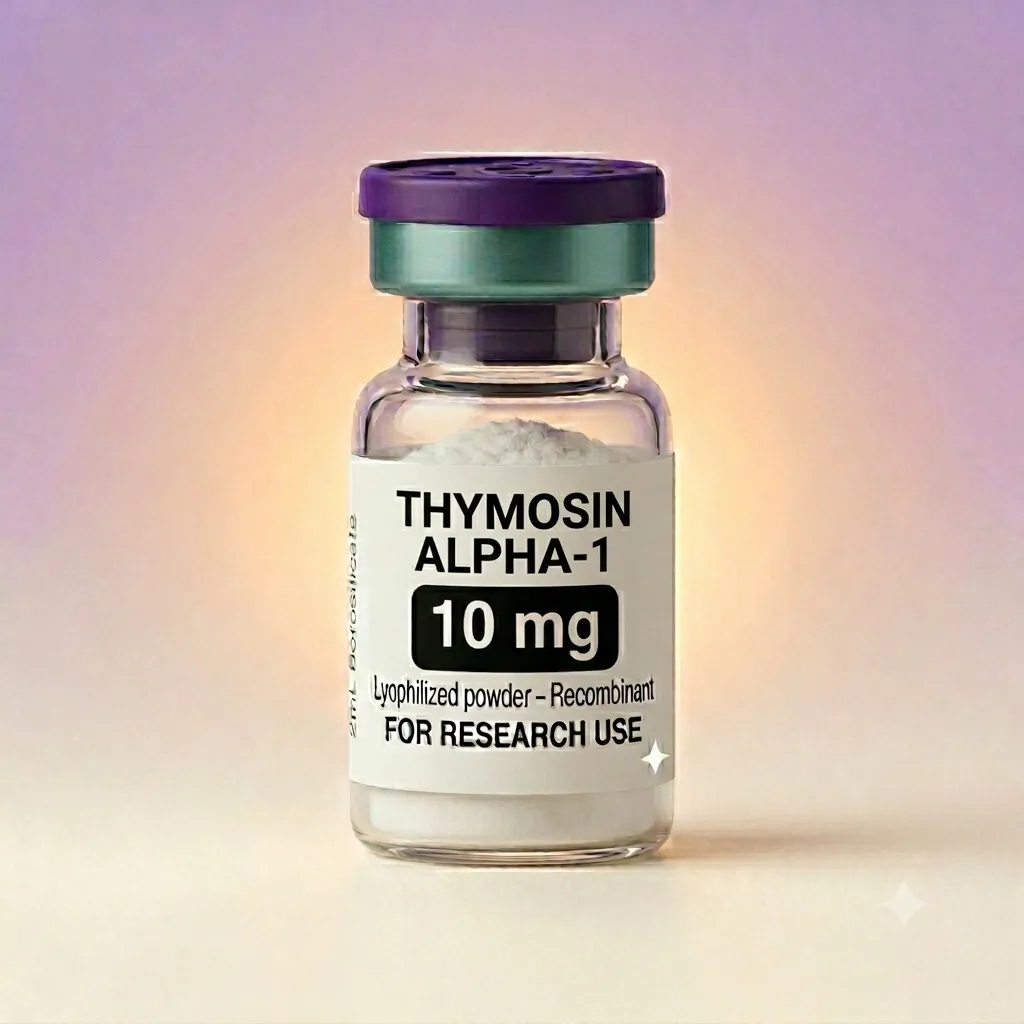
General Description
Thymosin Alpha-1 peptide, also known as Thymosin Alpha, TA1, or Tα1, is a protein
molecule fragment that has been widely studied for its potential implications with the
immune system. Researchers have hypothesized that it contributes to T-cell production to
mitigate and alleviate infection and bacterial spread.(1)
Thymosin Alpha-1 is a natural polypeptide that researchers consider potentially restores
and enhances immune functions.(2) Thymosin Alpha-1 is considered to be one of the
polypeptides found in Thymosin Fraction 5, which is a crude extract of the thymus
gland.(3)
Since its discovery, a synthetically developed form of Thymosin Alpha-1 has also been
studied; researchers refer to the peptide as Thymalfasin.(2) Thymalfasin is composed of
28 amino acids, similar to natural Tα1, and is derived from a longer polypeptide
precursor composed of 113 amino acids, known as Prothymosin Alpha.(3)
The primary goal of early research on Thymosin Alpha-1(4) was to understand and examine
the peptide's immunomodulatory potential. Studies have suggested that the peptide may
increase the concentration of major histocompatibility complex (MHC) class I and
cytokine production, which can possibly lead to increased immune responses. The peptide
may also improve natural killer cell activity and foster phenotypic marker expression in
T cells, suggesting a multifaceted role in immune response modulation. Researchers
postulated that the peptide may also increase the expression of high-affinity
interleukin-2 receptors. This could potentially lead to more vigorous activation and
proliferation of T lymphocytes.
Researchers speculate that Thymosin Alpha-1 may stimulate potential targeted action on
helper T cells and cytotoxic T cell populations.(3) Tα1 can possibly induce T cell
differentiation (thymocytes) and terminal differentiation of blood lymphocytes.
Scientists postulate that it may elevate natural killer cell production and potentially
stimulate cytokine-mediated inflammation.(2)(3) Additionally, the peptide has been
studied for its potential to improve macrophage efficiency and functions as a modulator
of alpha thrombin activity.(3)
Specifications
- Molecular Formula: C129H215N33O55
- Molecular Weight: 3108.31 g/mol
- Other Known Titles: TA1, Tα1, Thymalfasin
Thymosin Alpha-1 Peptide and Immune System
In a clinical study,(5) 11 test subjects with different immune system dysfunctions were
evaluated to determine the levels of their natural killer (NK) cells and
lymphokine-activated killer (LAK) cells present in their system. It was observed that
immunodeficient subjects demonstrated a mean LAK cell activity of approximately 65%
compared to control subjects. Upon presenting Thymosin Alpha-1 to test subjects,
researchers observed an apparent increase in cytotoxic activity and NK cell activity.
A Phase II clinical trial(6) involved critically ill subjects with sepsis. The objective
was to evaluate the efficacy and safety of Thymosin Alpha-1 in severe sepsis. The study
was randomized into two groups: a control group with a placebo and an experimental group
with 1.6 mg of Thymosin Alpha-1 presented subcutaneously twice daily for 5 days. 361
subjects were included in the research. The primary outcome was death, recorded up to 28
days after initiation. Study results indicated a slight decrease in mortality within the
Thymosin Alpha-1 group by 26% compared to the control group with a 35% mortality rate.
The difference indicated that Thymosin Alpha-1 could be beneficial for severe sepsis,
but was not statistically significant.
Thymosin Alpha-1 Peptide and Inflammation
Studies suggest that Thymosin Alpha-1 may impact inflammatory mediators by affecting
Toll-like receptors (TLRs). TLRs are typically associated with innate and adaptive
immunity; therefore, TLR dysregulation can lead to autoimmune and inflammatory diseases.
Researchers suggest that Thymosin Alpha-1 could affect TLR signaling, potentially
improving the adaptive immune response and possibly mitigating inflammation and allergic
immune responses. This implies that Thymosin Alpha-1 may influence dendritic cell
activity, which is considered vital for T cell activation, thus modulating the immune
system.(3)
Thymosin Alpha-1 Peptide and Cancer
Initial Phase II clinical studies of Thymosin Alpha-1 were conducted in conjunction with
dacarbazine (DTIC) chemotherapy and interferon-alpha (IFN-α) in test subjects with
metastatic melanoma. Researchers suggested that combination therapy could lead to
potential improvement in overall survival rates and progression-free survival without
adding toxicity. However, more recent studies(8) used Thymosin Alpha-1 in combination
with IFN-α and DTIC in 488 test subjects with melanoma. Subjects were randomized into
combination therapy groups. The study outcome indicated that the addition of Thymosin
Alpha-1 did not appear to improve the overall survival rate (9.4 vs. 6.6 months) nor
progression-free survival (2.9 vs. 2.2 months).
Researchers also studied(9) the potential of Thymosin Alpha-1 in advanced hepatocellular
carcinoma (HCC). Treatment-naive test subjects were enrolled over a year. The primary
study outcome was survival, and secondary outcomes included time to progression and
disease stability. Results indicated that the median survival rate was 4.8 months for
patients with Thymosin Alpha-1 and 4.5 months for control subjects. The 12-month
survival rate was 19% for the Thymosin Alpha-1 group vs. 12% for the control group.
Overall, researchers concluded that Thymosin Alpha-1 did not induce any statistically
significant improvement in overall survival in liver cancer.
Thymosin Alpha-1 Peptide and Vaccines
Research(2) indicates that Thymosin Alpha-1 may act as an immune adjuvant, potentially
improving response to vaccines, particularly in immunocompromised individuals who often
do not generate sufficient protective antibodies. Thymosin Alpha-1 is believed to boost
antibody production and specific T-cell activation, thus potentially improving vaccine
efficacy against various diseases.
References
- Immunodeficiency, British
Society for Immunology. Published March 2017.
- Dominari A, Hathaway Iii D, Pandav K, Matos W,
Biswas S, Reddy G, Thevuthasan S, Khan MA, Mathew A, Makkar SS, Zaidi M, Fahem MMM,
Beas R, Castaneda V, Paul T, Halpern J, Baralt D. Thymosin alpha 1: A comprehensive
review of the literature. World J Virol. 2020 Dec 15;9(5):67-78.
- National Center for Biotechnology Information.
"PubChem Compound Summary for CID 16130571, Thymalfasin" PubChem.
- Garaci E. Thymosin alpha1: a historical
overview. Ann N Y Acad Sci. 2007 Sep;1112:14-20.
- Eckert K, Schmitt M, Garbin F, Wahn U, Maurer
HR. Thymosin alpha 1 effects, in vitro, on lymphokine-activated killer cells from
patients with primary immunodeficiencies: preliminary results. Int J
Immunopharmacol. 1994 Dec;16(12):1019-25.
- Li C, Bo L, Liu Q, Jin F. Thymosin alpha1
based immunomodulatory therapy for sepsis: a systematic review and meta-analysis.
Int J Infect Dis. 2015 Apr;33:90-6.
- Chadwick D, Pido-Lopez J, Pires A, Imami N,
Gotch F, Villacian JS, Ravindran S, Paton NI. A pilot study of the safety and
efficacy of thymosin alpha 1 in augmenting immune reconstitution in HIV-infected
patients with low CD4 counts taking highly active antiretroviral therapy. Clin Exp
Immunol. 2003 Dec;134(3):477-81.
- Qin Y, Chen FD, Zhou L, Gong XG, Han QF.
Proliferative and anti-proliferative effects of thymosin alpha1 on cells are
associated with manipulation of cellular ROS levels. Chem Biol Interact. 2009 Aug
14;180(3):383-8.
- Kharazmi-Khorassani J, Asoodeh A. Thymosin
alpha-1; a natural peptide inhibits cellular proliferation, cell migration, the
level of reactive oxygen species and promotes the activity of antioxidant enzymes in
human lung epithelial adenocarcinoma cell line (A549). Environ Toxicol. 2019
Aug;34(8):941-949.